
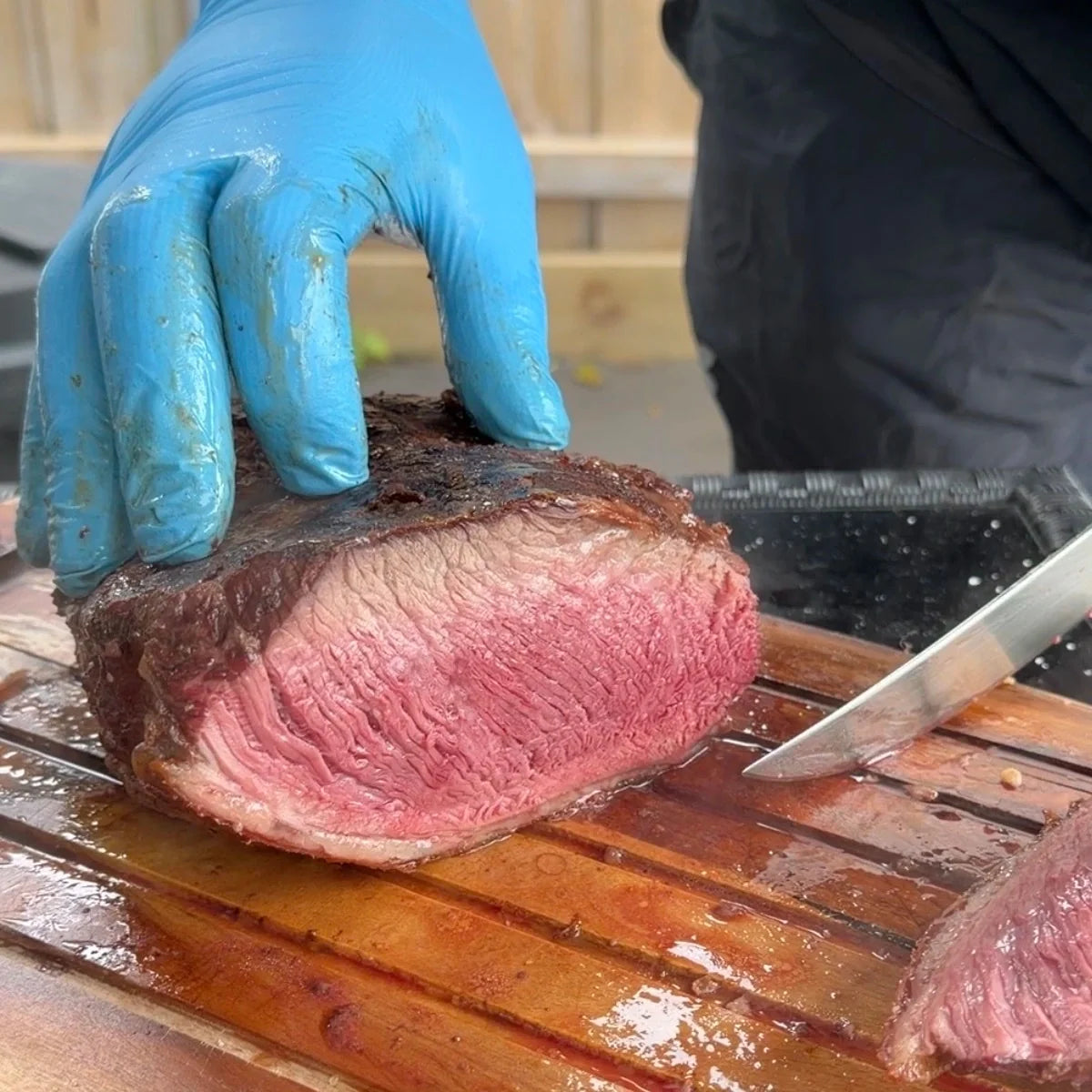
In Summary
- Picanha, or rump cap, can be cooked whole, cut into steaks or bent onto skewers, and all three work brilliantly over charcoal.
- How you cut it depends on the method: steaks are cut with the grain and sliced across it to eat, while skewer pieces are cut across the grain.
- I pull steaks and skewers at about 50°C (122°F) for medium-rare, and take a whole cap off at about 45°C (113°F) to rest before a hot reverse sear.
Picanha is rump cap: the triangle of beef off the top of the rump with a thick layer of fat on one side. You can cook it three ways: whole, as steaks, or Brazilian-style on skewers. Each one needs a different cut and a different heat, but the seasoning stays the same. Kosher salt, a good bed of embers and a thermometer. I cook all three regularly and I still can't pick a favourite.
Picanha three ways at a glance
| Whole | Steaks | Skewers | |
|---|---|---|---|
| How to cut | Leave it whole, fat cap on | With the grain, about 2cm thick | Across the grain, bent into a C |
| Heat (hand test) | Low, 6-8 seconds, then a hot sear | Hot, about 1 second | Medium-high, about 3 seconds |
| Pull at | About 45°C (113°F), then sear | About 50°C (122°F) | About 50°C (122°F) |
| Rest | 15-20 minutes before the sear, then a couple of minutes after | About 5 minutes | About 5 minutes |
| To serve | Slice thin, across the grain | Slice across the grain | Shave thin slices off the skewer |
The hand test: hold your palm at cooking height and count how long you can keep it there before you have to pull away.
What is picanha?
Picanha is the Brazilian name for the cap muscle that sits on top of the rump. Most Aussie butchers sell it as rump cap, and a whole one usually weighs somewhere around 1.2 to 1.8kg. The thick fat cap is the whole point. It melts slowly as it cooks and keeps the meat juicy, so I never trim it off.
If you want the full walkthrough for cooking one whole over embers, I've covered that in How To Cook Picanha On A Parrilla Grill. This post is about the three different ways to cook it, and how to cut it for each one.
Why does the grain matter so much?
The grain is the direction the muscle fibres run. Look at the meat side of the cap and you'll see the lines. When you eat beef sliced across those lines, the fibres are short and the meat is tender. Slice along them and even a perfectly cooked piece of picanha turns chewy.
Here's where people get caught out: the cut you make before cooking changes depending on the method. For steaks you cut with the grain, so that when you slice the cooked steak on your plate, you're going across it. For skewers you cut across the grain, because the meat gets sliced off the skewer in the same direction you cut it.
Check which way the grain runs before you season or cook anything, and take a quick photo of it on your phone. Once it's cooked and covered in salt and crust, the lines are much harder to see.
How do I cook a whole picanha?
Whole is the slow, relaxed way. My way is to cook it gently, take it off early, rest it, then hit it with a hard sear at the end. That's a reverse sear: low heat first, high heat last.

- Score the fat cap. Cut a crosshatch pattern into the fat with a sharp knife, without cutting into the meat. It helps the fat render and gives the salt somewhere to sit.
- Season it. Kosher salt on all sides.
- Set up a gentle fire. You want low heat at cooking height, about 6-8 seconds on the hand test. Start with the fat cap facing the heat.
- Cook it to about 45°C (113°F) in the thickest part. Use a thermometer, not the clock. A 1.2kg cap won't cook like a 1.8kg one.
- Rest it for 15-20 minutes, loosely tented with foil. Don't wrap it tight.
- Get the fire hot and sear it on all sides until you've got the crust you want and the fat cap is golden.
- Pull it, rest it for a couple of minutes, then slice it thin, across the grain.
Pulling it at 45°C (113°F) can feel early, but the rest and the sear carry it up into medium-rare. On a parrilla you can also cook it straight over embers: fat cap down, flip at about 40°C (104°F) and pull at 50°C (122°F). Both work. The parrilla post covers that method step by step.
How do I cut and cook picanha steaks?
Steaks are the quickest of the three. Cut the cap with the grain into steaks about 2cm thick, each with a strip of fat on top. Season with kosher salt.
Cook them over high heat, about 1 second on the hand test, turning them as they colour. At 2cm thick they come up to temperature quickly, so start checking early. I pull them at about 50°C (122°F) for medium-rare. Rest them for about 5 minutes, then slice across the grain to eat.
If you want a deeper crust on thicker steaks, the same reverse sear idea works here too. I've compared the two methods in Reverse Sear vs Sear-First.
I try to rest big cuts for 15-20 minutes, but with steaks I'm sometimes impatient. The good news is that tests have found the difference in juice lost between a rested and an unrested steak is tiny. Five minutes is plenty.
How do I make Brazilian-style picanha skewers?
This is the churrasco way, and I cook picanha like this all the time.
- Cut across the grain into thick pieces about 4-5cm wide (roughly three fingers), each with fat on top.
- Bend each piece into a C with the fat cap on the outside, then push the skewer through both ends.
- Season with kosher salt.
- Cook over medium-high heat, about 3 seconds on the hand test, turning so every side gets colour and the fat renders.
- Pull at about 50°C (122°F) and rest for about 5 minutes.
- Serve by shaving thin slices off the skewer. Because you cut across the grain at the start, every slice comes off tender.

Wide 20mm flat stainless steel skewers, a good size for chunky pieces of picanha.
$45.00 View product →What should I season picanha with?
Salt. That's it for me most of the time. I use kosher salt and rarely bother with a rub on picanha steaks. The beef and the fat do the work. The coarse flakes are easy to spread evenly and you can see how much you've used. If you're wondering how it's different from table salt, I've explained it in What Is Kosher Salt? An Australian Guide.

The salt I use on picanha, whichever way I cook it.
$10.00 View product →What should I serve with picanha?
Chimichurri. We love it with picanha, whichever way it's cooked. It's a fresh, tangy herb sauce from Argentina, and it cuts through the rich fat cap beautifully. Spoon it over the meat after it's rested, not while it's cooking.
We sell a ready-to-go blend, so you don't have to chop a pile of herbs. You just add olive oil, fresh parsley and red wine vinegar. The method on the pack is:
- Put 1/4 cup of the TKC Chimichurri Chubby blend in a bowl.
- Add 2 tablespoons of red wine vinegar.
- Add 1/2 cup of olive oil.
- Stir in 1/4 cup of chopped fresh parsley.
- Let it sit for 10-15 minutes so the dried herbs soften before serving.

Just add olive oil, fresh parsley and red wine vinegar for fresh chimichurri in minutes.
$20.00 View product →Do I really need a thermometer?
For picanha, yes. Every cap is a different size, the fat cap varies, and wind and ember heat change the cook. Some experienced cooks go by touch. I use a thermometer every time, and the one I use and recommend is Inkbird. An instant-read one is all you need for steaks and skewers.
It's also why you can enjoy picanha pink in the middle. Whole cuts of beef like steaks and roasts can be served rare because the bacteria sit on the outside of the meat, and searing deals with them. That's different from mince, which has to reach 75°C (167°F) right through.

Fast, accurate checks on steaks and skewers.
$35.00 View product →Common mistakes
Cutting steaks the wrong way
Cut picanha steaks across the grain before cooking and you end up slicing them along the grain on the plate. That's when perfectly cooked picanha turns chewy.
Trimming the fat cap
Leave it on. It renders as it cooks and keeps the meat moist. You can always cut some off on your plate.
Cooking a whole cap over big flames
Flames burn the fat before the inside is anywhere near ready. Give the whole cap gentle heat and save the high heat for the sear at the end.
Cooking by time instead of temperature
Cap size, fat thickness, wind and how hot your embers are all change the cook. Go by the thermometer.
Wrapping it tight while it rests
A tight foil wrap steams the outside and softens the crust you worked for. Rest it uncovered or with a loose tent.

Dense hardwood lump with a long burn and low ash, from the gentle whole-cap cook to the final sear.
$49.00 View product →FAQ
Is picanha the same as rump cap?
Yes. Picanha is the Brazilian name for rump cap, the cap muscle from the top of the rump with the fat layer on one side. Ask your butcher for rump cap with the fat left on.
Should I cut picanha with or against the grain?
It depends how you're cooking it. For steaks, cut with the grain, then slice across it to eat. For skewers, cut across the grain so the slices you shave off are tender.
What temperature should I pull picanha at?
For medium-rare steaks and skewers, I pull at about 50°C (122°F). For a whole cap that's getting a reverse sear, I take it off at about 45°C (113°F), rest it, then sear it.
Do picanha steaks need to rest?
About 5 minutes is plenty. Tests on steaks have found the difference in juice loss between resting and not resting is small, so don't stress if you cut in early.
Can I cook picanha on a normal charcoal BBQ?
Yes. All three methods work over any charcoal BBQ as long as you can set up a gentle zone and a hot zone. A parrilla just makes it easier, because you can raise or lower the grill to change the heat.
Keep reading
- How To Cook Picanha On A Parrilla Grill
- Reverse Sear vs Sear-First: How to Get Steakhouse Crust on Charcoal
- What Is Kosher Salt? An Australian Guide
- Skewers, Shish & Kebab Cooking Guide
If you can't decide which way to go, grab a bigger cap, cut half into steaks and put the rest on skewers. That's the best way to work out your favourite. I still haven't picked one.